

The project life cycle, pivotal in project management, offers a framework from project start to finish. It traditionally encompasses initiation, planning, execution, monitoring & controlling, and closing. However, its application is more nuanced, extending through the project’s entire journey, with each phase potentially including sub-phases like planning and funding in a construction project. Within each phase, initiation sets the scope, timeline, and budget, followed by detailed planning, execution, and monitoring to ensure adherence to the plan. Each project’s cycle varies, emphasizing the importance of viewing these stages as adaptable process groups rather than rigid steps.
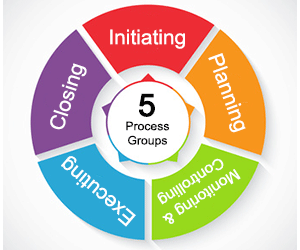
Let’s dive into each:
Initiation Stage:
In the initiation stage of a project, the main focus is on defining the project at a high level and getting the necessary approvals to move forward. This stage typically involves identifying the project’s purpose and objectives, outlining the project scope, identifying key stakeholders, conducting a feasibility study or needs analysis, and developing a project charter or a similar document. The project charter formally authorizes the project and includes key information such as the project scope, objectives, stakeholders, and high-level requirements. This stage is critical for setting the foundation for all subsequent project activities. The project manager is not too involved in this stage until closer to the end.
To simplify this stage (and the subsequent stages), I will list the ITTO for each to clarify the process more. ITTO stands for Inputs, Tools & Techniques, and Outputs.
Inputs: Project statement of work, business case, agreements, and enterprise environmental factors.
Tools and Techniques: Expert judgment, data gathering (e.g., brainstorming, focus groups), and meetings.
Outputs: Project charter and stakeholder register.
This stage is crucial for defining the project’s purpose, aligning expectations, and securing the necessary authorization to proceed.
Planning Stage:
In the planning stage of a project, a detailed roadmap is developed that will guide the project to successful completion. This stage involves defining project objectives, deliverables, and activities. Key tasks include developing a project management plan, which encompasses plans for scope, schedule, cost, quality, resources, communications, risk, procurement, and stakeholder engagement. Additionally, setting baselines for scope, schedule, and cost to measure project performance is crucial. Effective planning ensures that the project team has a clear understanding of the project’s goals, processes, and constraints, facilitating better decision-making and project execution.
Inputs: Project Charter, Stakeholder Register, Enterprise Environmental Factors (EEFs), Organizational Process Assets (OPAs)
Tools and Techniques: Expert Judgment, Data Gathering (brainstorming, interviews, etc.), Data Analysis (alternative analysis, cost-benefit analysis, etc.), Meetings
Outputs: Project Management Plan (includes subsidiary plans for scope, schedule, cost, quality, resource, communications, risk, procurement, and stakeholder engagement); Baselines (Scope Baseline, Schedule Baseline, Cost Baseline), Project Documents Updates (risk register, stakeholder register, etc.)
These elements structure the comprehensive approach to planning in project management, ensuring a clear roadmap for project execution.
Execution Stage:
During the execution stage of a project, the team works on completing the tasks outlined in the project management plan. This stage involves allocating resources, executing project plans, performing the tasks required to meet the project’s objectives, and adhering to the project’s timeline and budget. Communication with stakeholders is continuous to report progress. The focus is on delivering project deliverables and meeting defined quality standards. This stage is crucial for the tangible realization of the project’s goals through the coordinated efforts of the project team.
Inputs: Project Management Plan, Project Documents, Approved Change Requests, Enterprise Environmental Factors, Organizational Process Assets
Tools and Techniques: Expert Judgment, Project Management Information System (PMIS), Meetings
Outputs: Deliverables, Work Performance Data, Change Requests, Project Management Plan Updates, Project Document Updates
This stage focuses on using the project management plan to execute project work and produce project deliverables, while also implementing approved changes and updating project documents as necessary.
Monitoring and Controlling Stage:
During the Monitoring and Controlling stage of a project, the focus is on tracking, reviewing, and regulating the progress and performance of the project. This involves measuring project activities against the project management plan and project performance baselines to identify any variances and implement necessary changes.
Inputs: Project Management Plan, Project Documents, Work Performance Data, Agreements, Enterprise Environmental Factors, Organizational Process Assets
Tools and Techniques: Expert Judgment, Data Analysis (e.g., variance analysis, trend analysis), Decision Making (e.g., change control board), Meetings
Outputs: Work Performance Reports, Change Requests, Project Management Plan Updates, Project Documents Updates
This stage ensures the project remains on track to meet its objectives and can adapt to changes or issues as they arise.
Closing Stage:
In the Closing stage of a project, the focus is on formally completing and closing the project or a project phase. This includes finalizing all activities, ensuring project deliverables are accepted, and formally closing out project contracts and documentation. The objective is to ensure the project is completed satisfactorily and all administrative tasks are concluded.
Inputs: Project Charter, Project Management Plan, Project Documents, Accepted Deliverables, Business Documents
Tools and Techniques: Expert Judgment, Data Analysis, Meetings
Outputs: Project Documents Updates, Final Product, Service, or Result Transition, Project or Phase Closure Documents
Each stage of the project life cycle plays a significant role in the success of a project. Understanding these stages helps project managers and teams navigate the complexities of project management, ensuring a structured and effective approach to achieving project goals.
 deliberatedevelopment.org