

Scroll for more than 30 seconds and you’ll see it: another post calling half the country wrong, immoral, or just plain stupid. Sometimes it’s political, sometimes cultural, but it’s always emotional.
We’ve all seen someone drop a fiery meme or video clip, mic-drop the comments, and walk away like they just saved democracy. But here’s the truth: those posts aren’t changing minds. They’re just deepening division.
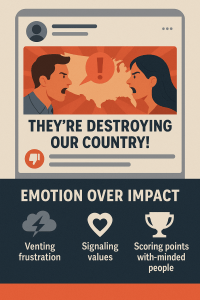
Emotion Over Impact
Let’s be honest—most political or cultural posts aren’t really about persuasion.
They’re about:
- Venting frustration
- Signaling values
- Scoring points with like-minded people
They aren’t written with curiosity or openness, they’re designed like weapons. They trigger responses, not conversations.
So why do we post them?
Because it feels like action. In a chaotic world, it gives us the illusion of control. It helps us feel seen, like we’re standing for something. Posting can become a badge of identity or a way to align with our tribe and say, “This is who I am.”
But more often than not, these posts are reactions, not reflections. Many aren’t even accurate, they are just emotionally charged soundbites taken out of context.
The Spin Game: A Clear Example
Let’s take a line from Lincoln’s Gettysburg Address:
“Government of the people, by the people, for the people, shall not perish from the earth.”
Sounds noble, right?
Here’s how it could be spun today:
“Lincoln clearly warned that if we don’t eliminate big government, America will perish. He wanted a populist revolution, not federal overreach. The Founders would be ashamed of what we’ve become.”
See what just happened?
A line that was meant to honor sacrifice and unify the nation gets twisted into a rallying cry for anti-government sentiment. It turns a call for democracy into a wedge issue.
Absurd? Yes. But believable? Also yes. In fact, here are some actual quotes from Lincoln criticizers:
The Chicago Times (a Democrat-leaning paper) said: “The cheek of every American must tingle with shame as he reads the silly, flat, and dishwatery utterances of the man who has to be pointed out to intelligent foreigners as the President of the United States.”
The Harrisburg Patriot & Union (another Democratic paper) called it: “A perversion of history so flagrant that the most extended charity cannot regard it as otherwise than willful.”
Ironically, over 100 years later, that same paper issued a retraction in 2013, admitting their criticism was wrong.
That’s what makes spin so dangerous. We isolate a phrase, strip it from its historical and emotional context, and weaponize it for our own agendas and because the quote is technically real, it feels true.
Attention Isn’t Impact
We confuse attention with influence. We think if we word something just right, someone will finally “get it.” But beliefs don’t shift because of a clever zinger. They’re rooted in:
- Personal experience
- Emotional identity
- Core values
- Community bonds
Social media doesn’t reward understanding. It rewards outrage. It doesn’t teach us to listen, it teaches us to broadcast. Over time, many of us forget how to have real conversations with people who think differently.
Why This Doesn’t Work
You’re not going to out-logic someone in a comment thread, especially if they feel attacked.
Here’s why:
- People don’t change when they feel cornered.
- Beliefs are emotional first, intellectual second.
- Social media lacks the tone, trust, and nuance required for persuasion.
A Better Way: Curiosity Over Condemnation
Years ago, I used to write in Christian forums. One day, someone posted something ignorant about Christians. Instead of lashing out, I simply asked: “Why do you feel that way?”
At first, the replies were defensive, but I kept asking. I wasn’t trying to trap him; rather, to understand him. Eventually, he let his guard down and we had a real conversation.
Did either of us change our beliefs? No. But we respected each other and walked away better for it.
Imagine if more online conversations started that way.
Before You Post, Ask:
- Am I trying to connect—or just correct?
- Would I say this to a respected friend who disagrees with me?
- What would it look like to ask instead of assume?
Maybe instead of:
“If you support X, you’re part of the problem…”
Try:
“I’ve been wrestling with this issue. Can anyone help me understand the other side?”
It won’t go viral. But it might build trust.
Influence > Outrage
Leaders don’t just express opinions—they build bridges. You don’t have to silence your values. But if your goal is impact, not just catharsis, choose influence over outrage.
Because half the country isn’t dumb and they’re not evil. They just see the world through a different lens.
If you started from that assumption—how would your tone change?
Let’s be the kind of people who model better conversations—not just shout into the void.
 deliberatedevelopment.org