
Every leader wants to see meaningful change. The problem is that most of us overestimate what we can accomplish in a week and underestimate what we can accomplish in a year. Big goals sound inspiring at first, but they often collapse under the weight of unrealistic expectations.
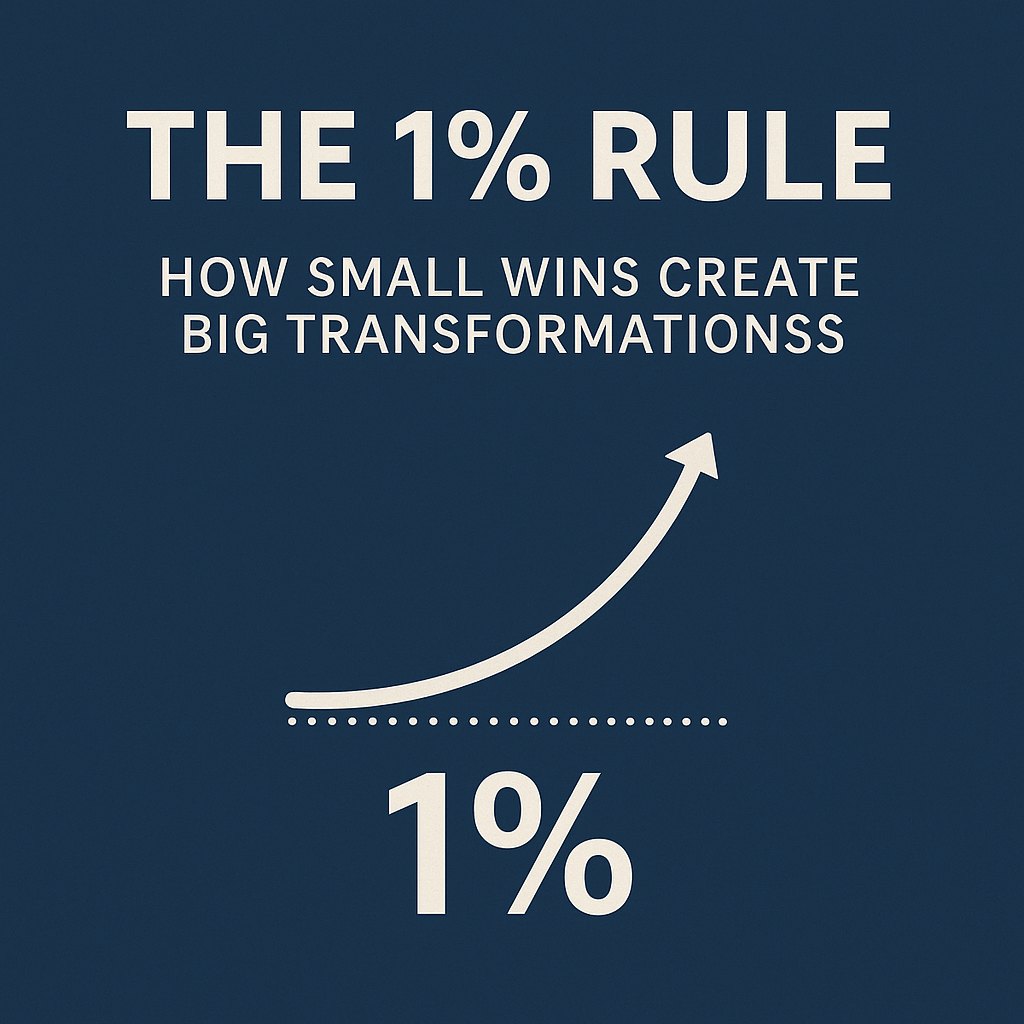
Real growth rarely happens in leaps. It happens in layers. One small, deliberate improvement each day compounds into extraordinary progress over time. This is the essence of the 1% Rule: consistent, incremental growth that builds momentum and mastery.
The Leadership Problem: Ambition Without Structure
Ambition is not enough. Many leaders set goals that depend on motivation instead of system design. They rely on willpower, but willpower fades. Systems sustain.
James Clear’s Atomic Habits illustrates that habits are the compound interest of self-improvement. A 1% improvement each day may seem insignificant, but over the course of a year it results in exponential growth. The same principle applies to leadership. A leader who improves one process, one conversation, or one decision each day creates an unstoppable culture of progress.
The 1% Approach in Practice
The 1% Rule aligns perfectly with deliberate development. It turns daily discipline into visible transformation. Here is how to apply it:
- Break goals into micro-wins.
Choose one small improvement you can make each day. It could be as simple as reading for 10 minutes, giving one piece of feedback, or finishing a key task before checking email. - Focus on systems, not outcomes.
Your goal is the direction; your system is the path. A strong system turns success into a habit rather than a moment. - Track your progress.
The act of measuring builds momentum. Create a simple chart or journal that marks one daily improvement toward your larger goal. - Build habits on top of habits.
Stack new habits onto routines you already have. For example, “After I pour my morning coffee, I will write one sentence in my growth journal.”
Applying It as a Leader
Leaders who model small daily improvements inspire teams to do the same. When a leader learns openly, practices consistency, and celebrates small wins, that behavior spreads.
Encourage your team to focus on “better” rather than “perfect.” Ask each member to identify one skill, system, or relationship they can improve by 1% this week. Create space to share progress during team huddles. Over time, this rhythm builds trust, accountability, and pride in growth.
A Practical Exercise
Pick one professional and one personal goal for the month. Write out the daily 1% improvement that supports each. Then commit to tracking it for 30 days. Do not worry about perfection. The goal is progress you can see and sustain.
Why It Matters for Leaders and Mentors
The best leaders are not obsessed with speed. They are obsessed with direction. The 1% approach keeps you moving forward even when motivation wavers. It transforms lofty goals into daily victories that build confidence and competence for the long term.
Deliberate development is not about doing more. It is about becoming more.
“Success is the product of daily habits, not once-in-a-lifetime transformations.”
— James Clear
 deliberatedevelopment.org