

Whenever we are faced with a problem, our solution almost always comes down to a two-way decision. “Do we take the new job or do we stay put? Do we push the new release out a sprint or force overtime onto the team?” Without fail, whenever a problem arrives, the team very quickly narrows things down to a binary decision. I have never looked into the science as to why this is, but it is definitely human nature. (Side note: If you know what this called, share it with me.)
The way things typically unfold are: a problem arises, we look at what has been done in the past, we choose one of those options. However, when we find an alternative solution, it is almost always better for the team at large. Years ago, we had a mission that needed our C-17 to be prepped for. The location the aircraft was going to required countermeasures (flares) to be installed; however, only certain vehicles could transport these based on their explosive nature. The vehicle was not available for at least 5 hours and there was inclement weather forecasted that would not allow us to load the flares if we waited for the truck. We were faced with two decisions right off the bat, “Do we wait for the transport vehicle in hopes the weather will hold out or do we just accept the fact the mission will be late due to weather?” Both of these are the normal or usual responses to this situation.
Our Pro Super took a step back and found an alternative solution. He looked ahead at the mission schedule for the coming days and saw there was an aircraft with countermeasures installed that didn’t need them for its next flight. So, we downloaded them from that aircraft and towed the aircraft off the spot. Then, you guessed it, we towed the mission bird onto that spot and uploaded those flares. This not only solved the problem, it saved the next shift time and effort by prepping the other aircraft.
Sounds great, so why don’t we do stuff like this all the time? Abraham Maslow taught, “If the only tool you have is a hammer, you tend to see every problem as a nail.” Basically, if I were to give you a hammer and said to pound in loose nails, you would walk all around the building and pound every one of them in. You would most likely walk right past other issues you see and might not even notice them at all—you are a hammer. When faced with a problem, we see it through the lens we are wearing. These lenses are formed by our strengths, skillsets, training, and experiences and most of the time, this is a good thing. However, as leaders, the problems that get pushed to us are not always ‘loose nail, hit nail.’ We need to learn to see the whole picture and find the root issues.
What do we do then? Change our lens. My kids and I did an engineering course during Covid to keep them busy and have some fun in a different way. Little did I know, this course would help me to articulate something I have always referred to as the Third Option.
This course suggested to look at the actual problem and define the elements of it. For example: the aircraft needed countermeasures installed, the countermeasures couldn’t be moved for at least 5 hours.
He warned of people just trying to tweak the wheel to make it faster. For example: call ahead to the countermeasures backshop and have them ensure the flares are ready to go once the transport gets there or to look for another efficiency on the usual sequence of events. There is nothing wrong with tweaking the normal sequence to make it more efficient. In fact, this needs to happen regularly for continuous improvemnet. However, we instinctively know when we are trying to use old solutions for a new problem. This is when we need to look at the elements of the problem.
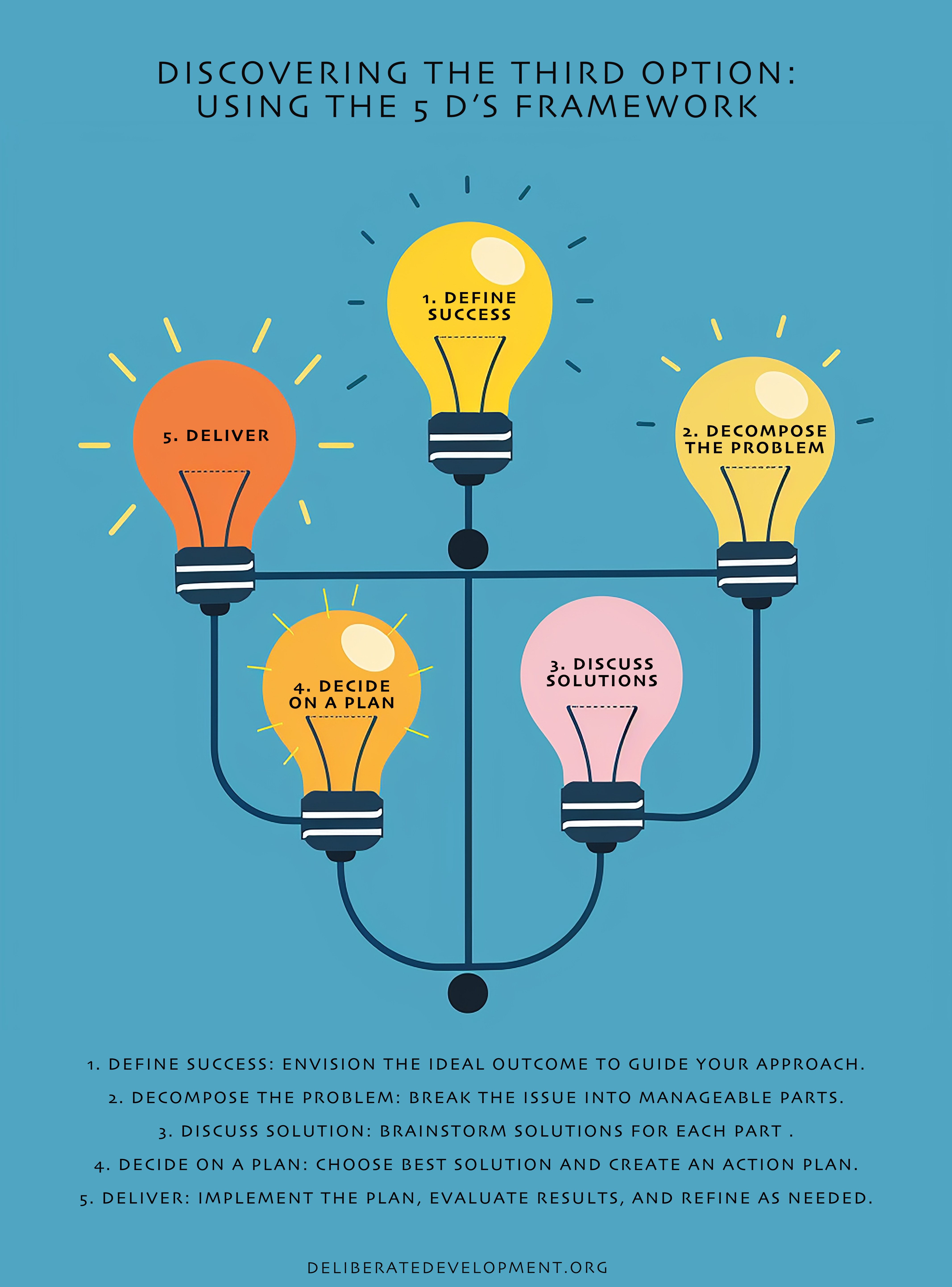
To break a problem down into its basic elements just takes a little extra effort and the 5 D’s:
- Define what success looks like. In project management, we call this the definition of done. What is the outcome you need or want? Don’t focus on how you normally get there, just what you want the final outcome to be.
- Decompose the problem. Break the issue down into the smaller components. We need countermeasures installed. We need countermeasures to install.
- Discuss ways to solve. How can you solve each of the smaller issues that you just defined? We want electric cars, but batteries aren’t powerful enough. Can we create a better battery? Can we alter the current technology to charge with the motion the car? How would we do each of these?
- Decide on a plan. Once you find an option above that seems like a viable solution and something your team is capable of, put it into motion. Back to the countermeasures example, if the team wasn’t capable of towing an aircraft or handling the flares, he would have needed a different solution.
- Deliver success. Did the plan work? If so, do a victory dance and hold your head high as you just innovated a new method others will surely implement. If it didn’t work, go back to step 3 above and try again. You will eventually find the solution that fits your situation.
Adopting a mindset where you seek out the Third Option allows leaders to create environments where creativity, critical thinking, and innovation will flourish. Encouraging ourselves and our teams to look beyond the binary thinking will build new skillsets and redefine the lens in which we see problems in the future.
 deliberatedevelopment.org